


The Business Case for Moving From Traditional Outreach to Direct Messaging

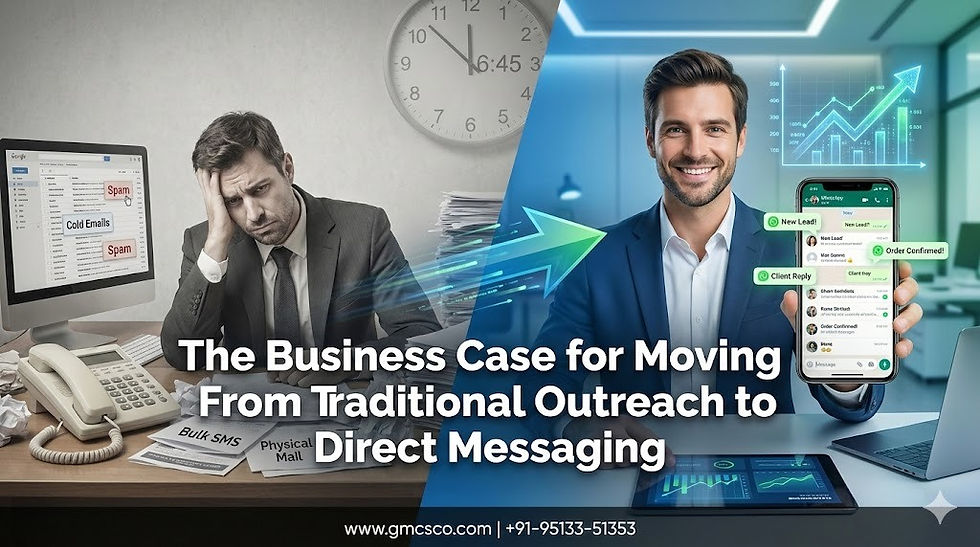
For decades, businesses relied on traditional outreach channels such as cold calls, print advertising, email blasts, television campaigns, and generic SMS promotions to reach their audience. While these methods once delivered impressive results, customer behavior has fundamentally shifted. Today’s consumers demand personalization, immediacy, and convenience. They prefer conversations over campaigns and engagement over interruption.
This transformation has forced organizations to rethink how they connect with prospects and customers. The move from traditional outreach to direct messaging is no longer a trend—it is a strategic necessity. Direct messaging platforms enable businesses to communicate in real time, deliver personalized interactions, and build meaningful relationships that convert faster and last longer.
In this blog, we’ll explore the complete business case behind this shift, the ROI advantages, operational improvements, and why forward-thinking brands are integrating solutions such as Whatsapp marketing into their long-term communication strategies.
The Limitations of Traditional Outreach
Traditional outreach methods are often expensive, slow, and difficult to personalize at scale. Let’s examine the core limitations:
1. Low Engagement Rates
Email open rates continue to decline across industries. Cold calls often go unanswered. Mass SMS campaigns are ignored or blocked. Consumers are overwhelmed with promotional noise, making it increasingly difficult for brands to stand out.
2. One-Way Communication
Most traditional channels operate as one-way messaging platforms. Television, billboards, radio ads, and even bulk emails broadcast information without enabling real-time conversation. Modern customers, however, expect interactive communication.
3. Poor Targeting Capabilities
Although digital ads allow segmentation, traditional outreach often struggles with precise targeting. This leads to wasted budget and reduced ROI.
4. Slower Conversion Cycles
When prospects must switch platforms to ask questions or complete purchases, friction increases. Every extra step reduces conversion rates.
These challenges are pushing businesses toward conversational channels where customers are already active—particularly messaging platforms.
The Rise of Direct Messaging in Business Communication
Direct messaging has evolved from personal chat apps into powerful business communication ecosystems. Platforms like WhatsApp, Messenger, and others have transformed into secure, scalable, and automation-friendly tools for enterprises.
Consumers check messaging apps multiple times daily. Unlike email inboxes cluttered with promotions, messaging apps are reserved for high-priority communication. This behavioral shift creates an enormous opportunity for businesses.
Through solutions like whatsapp business api service provider services, organizations can move beyond manual replies and adopt structured, automated, and compliant messaging systems.
Why Direct Messaging Outperforms Traditional Outreach
1. Higher Open and Response Rates
Messaging platforms consistently outperform email in open and response rates. Customers are far more likely to read and respond to a direct message than a promotional email.
2. Real-Time Conversations
Unlike broadcast marketing, direct messaging enables instant two-way communication. Customers can ask questions, clarify concerns, and make decisions faster.
3. Personalized Customer Journeys
Advanced messaging systems allow segmentation based on behavior, purchase history, and engagement patterns. Businesses can deliver tailored content rather than generic promotions.
4. Seamless Integration With CRM and Automation
Modern messaging APIs integrate with CRM platforms, helpdesk systems, and marketing automation tools, creating unified customer experiences.
Operational Efficiency and Cost Benefits
Shifting to direct messaging isn’t just about marketing performance—it significantly impacts operational efficiency.
Reduced call center load through automated replies
Lower marketing acquisition costs
Improved customer retention rates
Faster issue resolution cycles
Businesses operating in regions like Saudi Arabia are increasingly adopting Whatsapp business api integration saudi arabia services to streamline support and sales under one communication channel.
Trust, Verification, and Brand Credibility
One of the strongest arguments for structured direct messaging is credibility. Customers are cautious about spam and fraud. Verified business profiles build trust and ensure secure communication.
Understanding the Whatsapp verification process helps businesses establish authenticity and increase response rates while protecting their brand identity.
Direct Messaging for E-Commerce Growth
E-commerce businesses face intense competition and shrinking attention spans. Direct messaging solves multiple challenges simultaneously:
Abandoned cart recovery
Order updates and tracking
Personalized product recommendations
Post-purchase engagement
Customer feedback collection
Strategies such as whatsapp marketing for ecommerce enable online stores to convert conversations into revenue while improving customer satisfaction.
From Campaign-Centric to Conversation-Centric Marketing
Traditional outreach focuses on campaigns. Direct messaging focuses on conversations. This subtle shift changes everything.
Instead of asking, “How many people saw our ad?” businesses now ask, “How many meaningful interactions did we create?” Conversations provide data, intent signals, and engagement insights that traditional ads simply cannot deliver.
Strategic Implementation: Making the Transition Smooth
Moving from traditional outreach to direct messaging requires planning, compliance awareness, and technical integration. Businesses must choose reliable partners and infrastructure providers.
Selecting the right Whatsapp business solution provider ensures scalability, automation capability, analytics tracking, and compliance with messaging policies.
Organizations should begin with:
Audit of current outreach channels
Customer behavior analysis
CRM integration planning
Message template structuring
Automation workflow mapping
Performance measurement framework
Ready to future-proof your communication strategy? Explore tailored messaging solutions with GMCSCO and transform how your business connects with customers.
ROI Measurement and Performance Metrics
One of the biggest advantages of direct messaging is measurable performance. Businesses can track:
Delivery rates
Open rates
Response time
Conversion rate
Customer satisfaction score
Repeat purchase rate
Unlike traditional outreach, which often relies on estimated reach, messaging platforms provide concrete engagement metrics.
Competitive Advantage in Emerging Markets
Markets across the Middle East and globally are witnessing rapid adoption of business messaging platforms. Companies that transition early gain significant first-mover advantage.
With expert-led Whatsapp marketing expert guidance, businesses can deploy region-specific strategies that align with customer preferences and regulatory requirements.
Conclusion: The Future Belongs to Conversational Business
The shift from traditional outreach to direct messaging is not about abandoning marketing fundamentals—it’s about evolving them. Customers want speed, personalization, and convenience. Messaging delivers all three.
Businesses that continue relying solely on outdated outreach methods risk falling behind competitors who are building real-time customer relationships. By adopting structured messaging systems, integrating APIs, ensuring verification, and focusing on conversation-driven engagement, companies can increase conversions, strengthen loyalty, and reduce operational costs.
The business case is clear: direct messaging is more measurable, more personal, more efficient, and more aligned with modern customer expectations. The organizations that adapt today will define tomorrow’s market leaders.
Frequently Asked Questions (FAQs)
1. Why is direct messaging more effective than traditional outreach?
Direct messaging offers higher open rates, real-time interaction, and personalized communication compared to traditional broadcast methods.
2. Is direct messaging suitable for small businesses?
Yes, messaging platforms can scale for startups, SMEs, and enterprises with automation and API integrations.
3. How does direct messaging improve ROI?
It reduces acquisition costs, improves engagement, and accelerates conversion cycles through instant communication.
4. What industries benefit most from messaging strategies?
E-commerce, healthcare, education, finance, and real estate businesses benefit significantly.
5. Is verification necessary for business messaging accounts?
Yes, verification increases trust, improves deliverability, and enhances brand credibility.
6. Can messaging platforms integrate with CRM systems?
Yes, APIs allow seamless CRM, helpdesk, and marketing automation integrations.
7. How does messaging help in customer retention?
It enables proactive engagement, order updates, personalized offers, and fast issue resolution.
8. What compliance considerations should businesses keep in mind?
Businesses must follow opt-in policies, data protection laws, and platform-specific messaging guidelines.
9. How long does it take to implement a messaging solution?
Implementation timelines vary depending on integration complexity and verification requirements.
10. Is direct messaging the future of business communication?
Yes, conversational engagement is rapidly becoming the dominant and most effective communication strategy worldwide.


Comments